Information
·
Processed Data
·
First used in 1959
·
Derived from Latin word
·
The amount of information
is measured in bits.
Example: Information in one "fair" coin flip: log2(2/1) = 1 bit, and in two fair coin flips is log2(4/1) = 2 bits.
Example: Information in one "fair" coin flip: log2(2/1) = 1 bit, and in two fair coin flips is log2(4/1) = 2 bits.
Information Science
·
Science for managing and
inventing information
·
Interdisciplinary fields
incorporate with computer science, archival
science, cognitive science, commerce, communications,
law, library
science, museology,
management,
mathematics,
philosophy,
public policy,
and the social sciences.
·
Concern with analysis,
collection, classification, manipulation, storage and dissemination of
information
Information Society
·
Society which are more
influenced with creation, distribution and manipulating the information and
considering information as a prime source of development
·
The concept came in 1970
but it grows mainly in 1980 when some of scholars and writers encourage people
that “what information can do for them!”
·
The first group of
writers were “Masuda” in the Japanese context
Information as a Resource or Commodity
·
Information is used as a
resource as well as commodity.
·
Information as a resource
means using information to invent or generate some new knowledge.
·
Researchers are the
largest user of information; they use information as a resource.
·
Information as a
commodity means using information as a commodity like use of books, publication
of information in books, serial or journals or others.
Communication
·
Came from latin word
“communicare” which means “to share”
·
Means exchange of
thoughts, messages or information between two persons by speech, writing,
visuals, signal or behavior
Elements of Communication
·
Source
·
Encoder
·
Message
·
Communication
channel
·
Noise
·
Decoder
·
Destination
Models of communication
Lasswell model of communication
·
Harold
Lasswell developed this model in 1948
·
He was
U.S. Political Scientist and communication theorist.
·
His
theory was based on “who – says what – in which channel – to whom – with what
effects?”
Shannon and Weaver communication Model
·
This
model came in 1949 by two communication theorist Shannon and Weaver.
·
This
model has been called the “mother of all models”
·
This
model is also been criticized of being too mathematical (also called
mathematical theory).
Gerbner model of communication

·
This
model was developed by Mr. George
Gerbner in 1956.
(i) Perceptual Dimension:
This is simple to understand that if ‘E’ is a source of
information and passes his information to ‘M’ then it’s not exact same
information or knowledge ‘M’ is grabbing. It depends on the ability of ‘M’ that
how he interprets that information and that is where the value of information
is change according to the sense of understanding of ‘M’.
These 3 factors are involves between ‘E’ and ‘M’
·
Selection
·
Context
·
Availability
(ii) Means and
Controls dimension:
E2 is received information from M who is not the exact
source of information so the information which is delivered by M is based on priority
and understanding of M. In other words, the information is modified as per
preferences of M. So, the control and effectiveness on information is very low.
Important Note:
Message at every level is altered or changed.
Example:
In case of news reporting, E can be any event that has
happened and the reporter (M) selects a particular part of event (E1) that may
be provide his channel higher TRP ratings or the news may boost the particular
party which his channel supports. This SE2 is sent through a medium to the mass
audience. Then the audience distributed the message (SE2) and he (M1) sends to
his friends with his interpretation and the process continues.
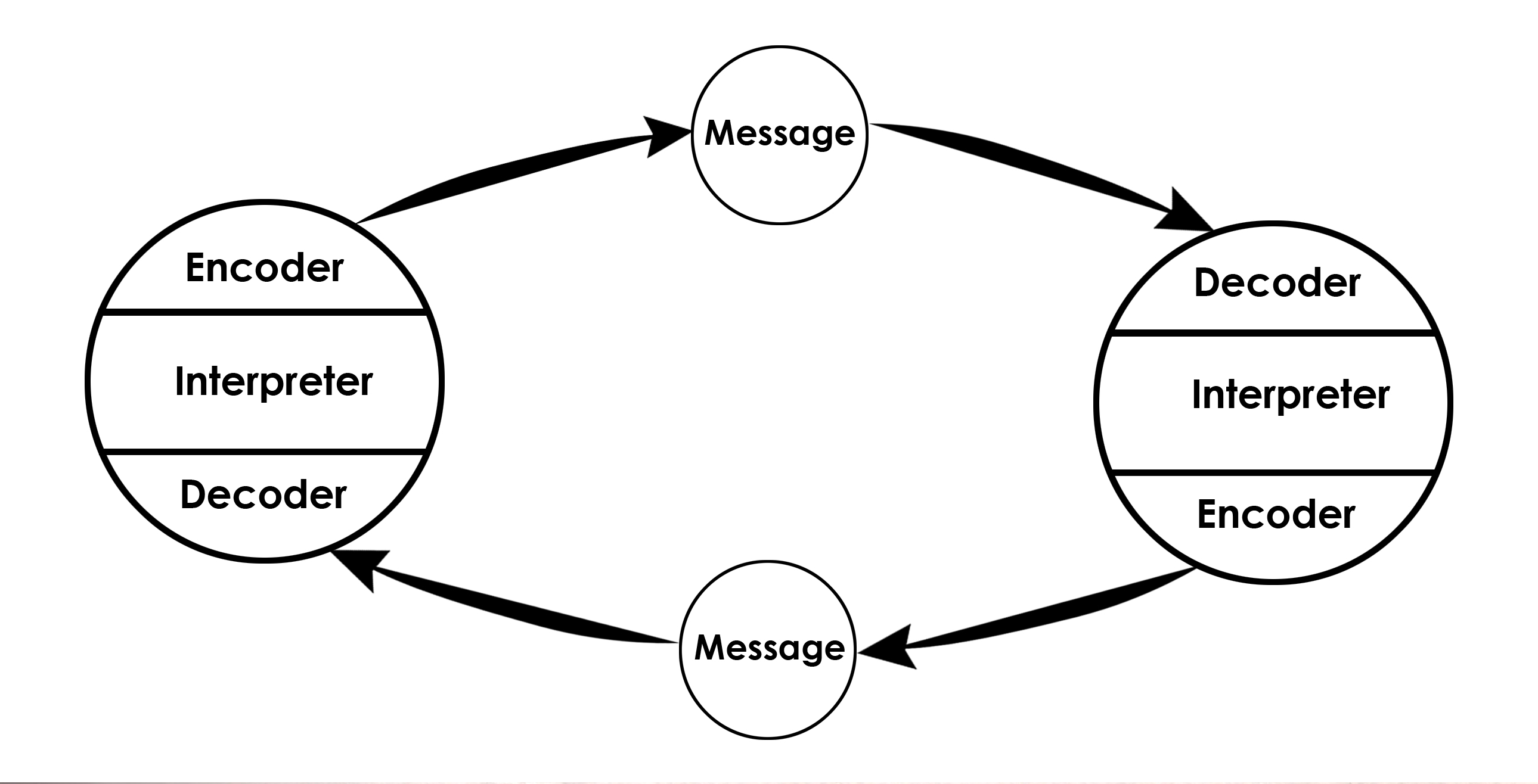
Schramm Model of Communication
· Wilbur Schramm developed this model of communication in 1954

This model is seems very natural and real act of communication
Encoder – Who send message
Decoder – Who receives message
Interpreter – Person (who received message) trying to understand (analyses, perceive) or interpret about message
Fact: Interpretation is goes on in this model of communication every time when a person receives or send message. This means only interpretation effects message every time and interpretation is depend on the knowledge and understanding of person
Semantic noise is a concept introduced here it occurs when sender and receiver apply different meaning to the same message. It happens mostly because of words and phrases for e.g. Technical Language, So certain words and phrases will cause you to deviate from the actual meaning of the communication.
Fact: When semantic noise takes place decoding and interpretation becomes difficult and people get deviated from the actual message.
Types of Communication:
·
Formal
Communication: Printed Materials (Books, Printed Document, Report etc.)
·
Informal
Communication: Audio- Visual Material, Non-Printed Materials, T.V., Radio etc.
Intellectual Property Right
Intellectual Property
·
A product
or service which is created by mind or intellectual thought of a person such as
invention or any artistic and literary work.
·
Therefore,
these inventions must be protected to encourage the inventors.
·
This is
where the concept of IPR comes into existence.
Patent
·
Exclusive
right granted for inventor who invent some new knowledge
·
With this
no one can use, sell, made a copy of his product without patent owner consent.
Copyright
·
Legal
right for a person who create artistic and literary work unique in its scope.
·
Works
covered under copyright range from books, music, painting, sculpture, films,
computer programs, database, advertisements, maps and technical drawing
·
Two
rights covered under copyright for holder:
(a): Economic Right: In this, Owner can give
permission to other for the use of his work and get financial reward.
(b): Moral Right: In this, Owner can take decisions
about the use of his product which could benefit him.
Trademark
·
It is
basically sign that represent a good or service for any big or small company.
·
Owner
gets this right initially for 10 years (most probably) but it can be extended.
Industrial Design
·
Right
given to the person or organization who creates some unique design
·
It may be
2D design or 3D.
·
This is
very important because:
If any company creates a design of car or bike
then, it is not case of producing one or two bikes. It requires lots of
investment and after that if that company realized that their design steals by
any other company. Then it may create a big problem for that company and it
discourages the inventions in design also. So, with this right company can
ensure its success with design without any fear of copying.
Geographical Indication
·
Sign that
used on the product which tells about its relation or origin of any specific
part of world.
·
It cannot
protect the product from copying but it protects only the sign of that product
which recognized its origin.
Copyright act in India
·
First law
on copyright is enacted on 1847 by then the governor general of India.
·
After
that Copyright act 1911 prevails until independence of India
·
And till
now it is amended several times.
·
The
latest amendment is done in 1994 which came in May 1995.
Fact
·
Berne Convention came in 9
Sept 1886 and being revised five times till 1971. It is administered by WIPO.
·
Every year on 26 April, World Intellectual Property
day is celebrated
·
Patent Cooperation Treaty (PCT): It came in 1978, 83
countries were its member till 1996. India is not yet a member.
·
Universal Copyright Convention (UCC): UCC came in
existence in 1952 and administered by UNESCO. It has 92 countries as its
member. India is also its member.
WIPO
·
186
member state
·
Headquarter:
Geneva, Switzerland

simple and best
ReplyDeletequick facts very nice works
ReplyDelete